Copenhagen Marathon Race Report: Five Marathons In, First Classic Done
Why Copenhagen
This race had three reasons on the same sticky note.
First: I'd planned to run it with a friend. Second: the European Marathon Majors Classics challenge had just launched, and Copenhagen was on the list, and if you're going to collect stamps, you might as well start. Third: I've made it a habit to run one marathon a year. May 10 was marathon number five.
What I hadn't fully accounted for was that my head had been somewhere else entirely. For the past several months my training had been pointed squarely at two triathlons, the X-Man Half Ironman Distance in Oradea in June and the London Triathlon in July. A full marathon three weeks out from that wasn't exactly the A-race. My target was 3:45. Not a dream time. Just honest math.
The Expo & The Wall of Runners
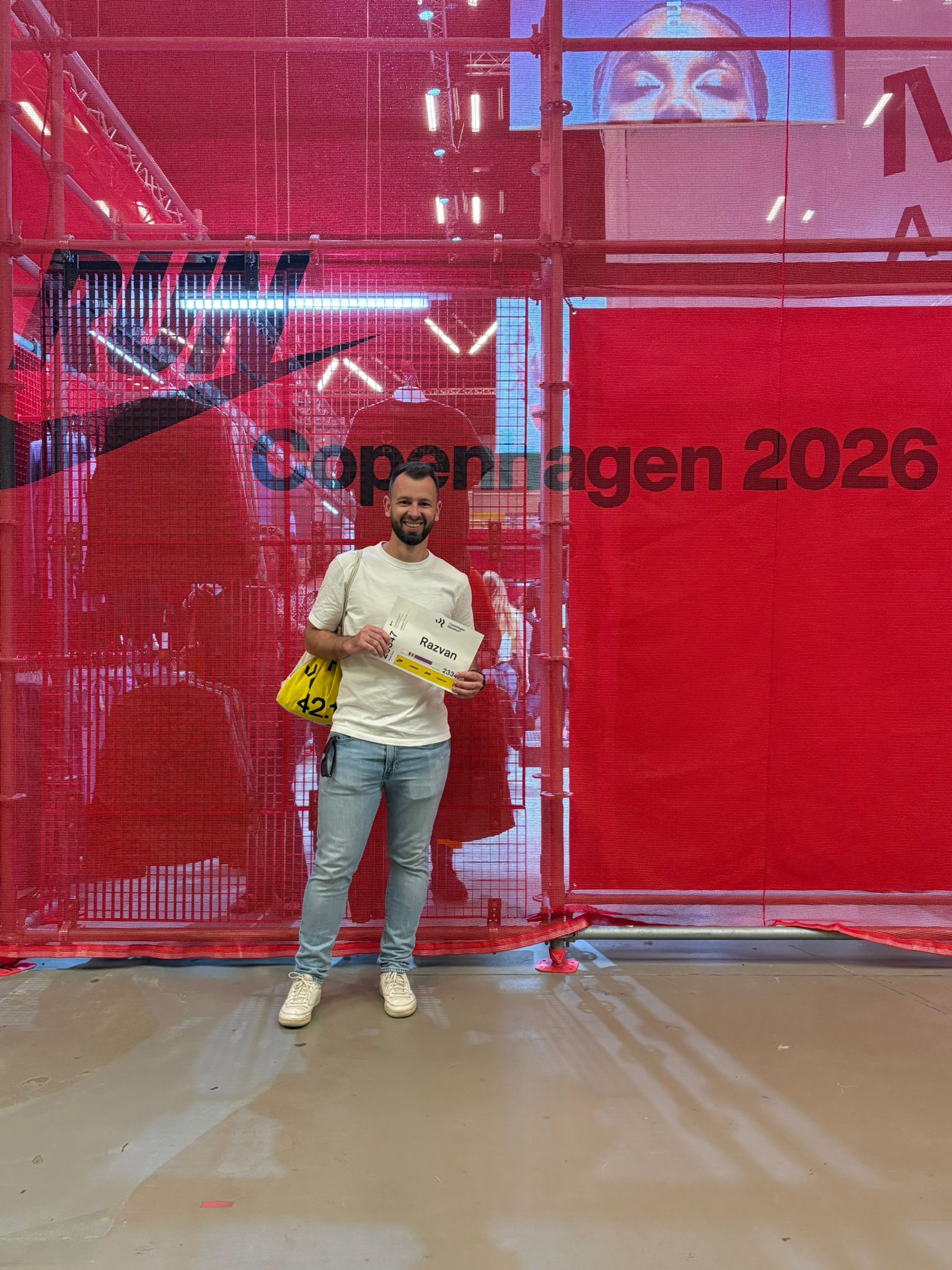
Copenhagen does race weekend properly. The expo was big, proper vendor halls, kit to try on, gels you didn't need, shoes you told yourself you'd think about. Standard. What wasn't standard was the Wall of Runners: a display showing every one of the 25,000 names registered for the race. I found mine. Somewhere between finding it and leaving the hall, it became real.
Race Morning
The alarm went off without ceremony. Breakfast was two slices of bread with honey, the same thing the sub-2 record holders apparently swear by, for whatever that's worth at my pace, plus a Maurten 320 mix. I showered, got my kit on, and left.
The nerves were specific. Not general pre-race anxiety, but two focused worries. One: I didn't feel like the training had been pointed at this distance. Two: 25,000 people is a lot of people. I run marathons, not crowd navigation courses. I wasn't sure how much energy I'd burn just moving through that density.
The Start
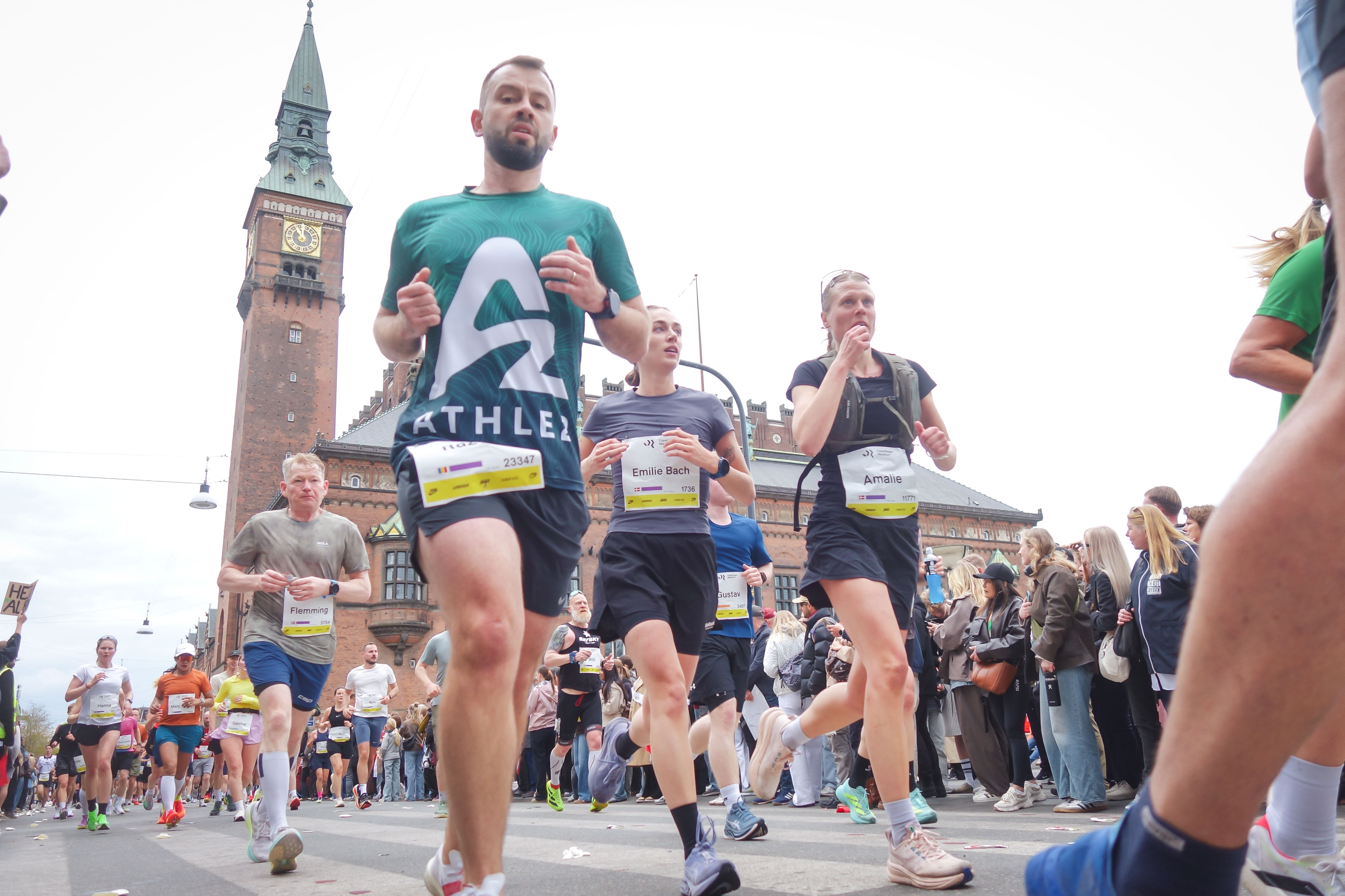
Every age, every pace, every flag you could think of, and the noise that comes with it, the kind that pulls you forward rather than pressing down on you.
I crossed the timing mat 22 minutes after the elites. The plan was loaded on my Garmin, a PacePro negative split strategy starting at 5:33/km and building down to 5:08/km. I took a gel right at the 9:30 gun, then found the 3:40 pacers and tucked in.
The First 10 Kilometres
Copenhagen at that hour is clean and fast. Wide roads, low sun, the city not quite awake yet. My body answered the first few kilometres well, better than expected, honestly. The PacePro plan had me arriving at km 10 ahead of pace by about two minutes. I let the race come to me rather than forcing it. When you feel it working, you don't fight it.
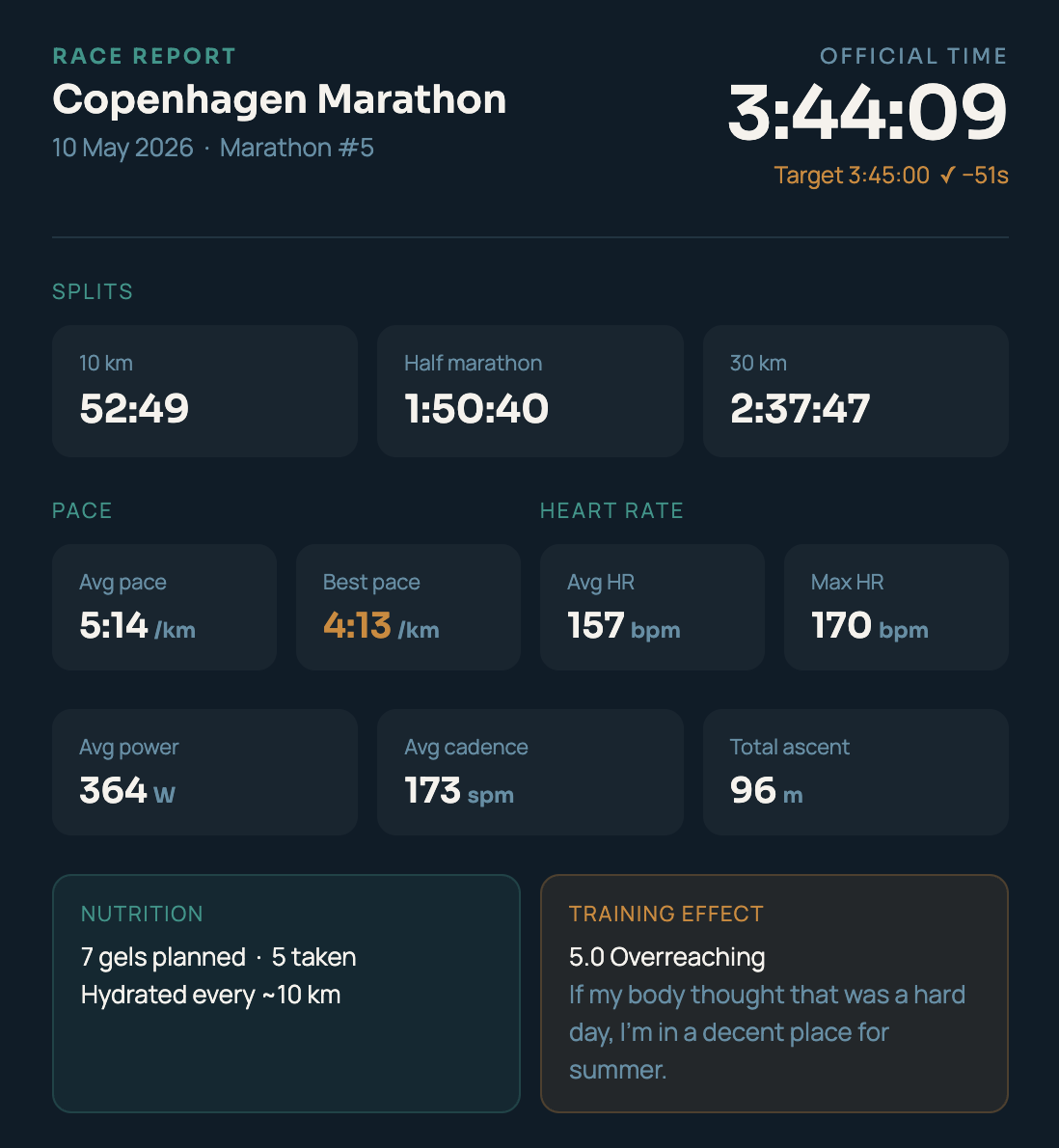
Km 10 done in 52:49.
The Middle — km 15 to 30
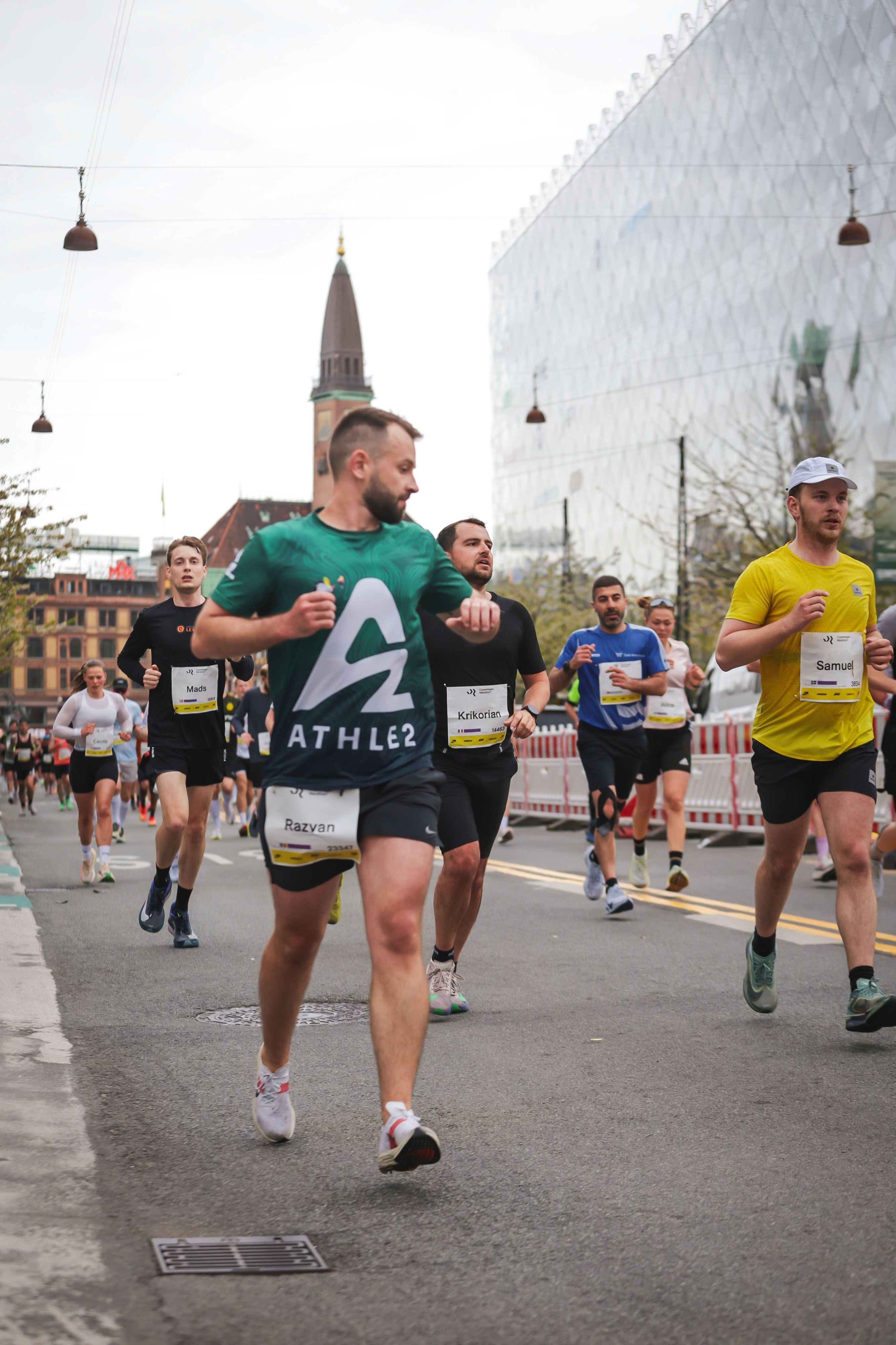
The middle of a marathon is where the race lives or dies. I've hit the wall hard before; my first two marathons made sure I understood what that meant. This one was different.
By km 25 I was four minutes ahead of schedule. The plan was a gel every 6 km, so by km 30 I was on gel five and felt clear-headed and steady. Heart rate sitting around 157. Legs doing their job.
And then, somewhere around km 28, Copenhagen did something I wasn't expecting.
A sponsor board on the course read: "Feel like hitting the wall? Here's a tunnel."
We went into a tunnel. DNB music, full volume, bouncing off the concrete. The kind of noise that gets into your legs before your brain has time to process it. I laughed out loud, which is either a sign of good spirits or mild hypoxia, probably both.
Coming out the other side, another sign: "Beat the wall."
I've never been thanked by a race course before. It counts.
The Final Push — km 30 to 42.2
No negotiation. That's the honest answer. The legs were there, the head was clear, and the plan held together.
One thing I noticed around km 36 was a toe that felt slightly wrong. I couldn't do anything about it mid-race, so I filed it away. By the time I got my shoes off, the toenail had gone black. The standard fee for finishing a marathon. I've paid worse.
In the final 2 km I was focused rather than inspired. No surge of emotion yet, that comes at the line, not before it. Reserves low, but the tank wasn't empty. I skipped the last gel. Didn't need it. Just kept the turnover going.
The Finish Line
The finish is a long straight boulevard. You see it before you're close enough to feel it. People sprinting around you, the big screen showing runners crossing, crowd noise that's been building for hours hitting a peak. I heard it before I saw the mat clearly.
I crossed the line and found my wife and a friend waiting on the other side. Someone handed me a banana and a bottle of water. I found a patch of grass and lay down on it.
The official time: 3:44:09.
My target was 3:45, and I finished 51 seconds inside it.
(Garmin records it slightly differently, 3:44:16 over 42.83 km. The extra 600 m explains the gap. GPS drift at that scale is just part of the deal.)
The Numbers
Recovery
I took three days completely off. The soreness was real, not bad, just present. Starting Thursday I'll build again. Oradea is six weeks out.
What This Race Actually Was
Copenhagen isn't a race I peaked for. It was a checkpoint, proof that consistent training compounds even when it's not pointed directly at the thing you're doing. The triathlon block I've been in since January is building something, and every once in a while a standalone race like this shows you what's been built.
I crossed a finish line 51 seconds faster than my target, in a city I'd never raced in, alongside 25,000 people who all wanted to be exactly there. That's what community looks like in practice, no speeches, no team kits, just 25,000 people walking toward the same start line at the same time and meaning it.
One down on the European Marathon Classics list. I want to run them all.
Next up: the X-Man Half Ironman Distance in Oradea on June 6, racing as a team alongside Andrei Chiorean and Aris Miuta. Three Athle2 athletes on the same start line. That one has been marked in the calendar since January.
The kit gets another outing in six weeks. See you in Oradea.